

Summary
At the very heart of Spain’s aviation network lies Adolfo Suárez Madrid–Barajas Airport (MAD) — the nation’s busiest and most important international gateway. From humble beginnings in the early 20th century to becoming one of Europe’s leading hubs, Barajas is a vital link between Europe and Latin America, a symbol of Spanish aviation growth, and a paradise for plane spotters.
Let’s explore how this immense airport works — its history, operations, and the airlines that make it tick — and discover where you can enjoy some of the best spotting opportunities in Spain.
From Humble Beginnings to Global Gateway
Madrid’s aviation story began modestly. The original Barajas airfield opened in 1931, serving as a simple terminal with a single hangar and unpaved runway. By the 1950s, as commercial aviation expanded across Europe, Madrid became Spain’s main connection to the outside world.
Through the 1960s and 70s, Barajas entered its first major expansion phase. Paved runways were extended, and modern passenger terminals replaced the old facilities. Iberia — Spain’s flag carrier — established Barajas as its home base, and the airport quickly became a symbol of the country’s modernization during the jet age.
The real transformation came in the early 2000s, when the government and airport operator AENA undertook a massive expansion to handle rising traffic. In 2006, the stunning Terminal 4 (T4) complex opened. It became one of Europe’s most impressive airport terminals and firmly established Madrid as a true intercontinental hub.
Today, Barajas handles more than 60 million passengers annually, serving over 200 destinations across Europe, the Americas, Africa, and Asia.
Layout and Operations
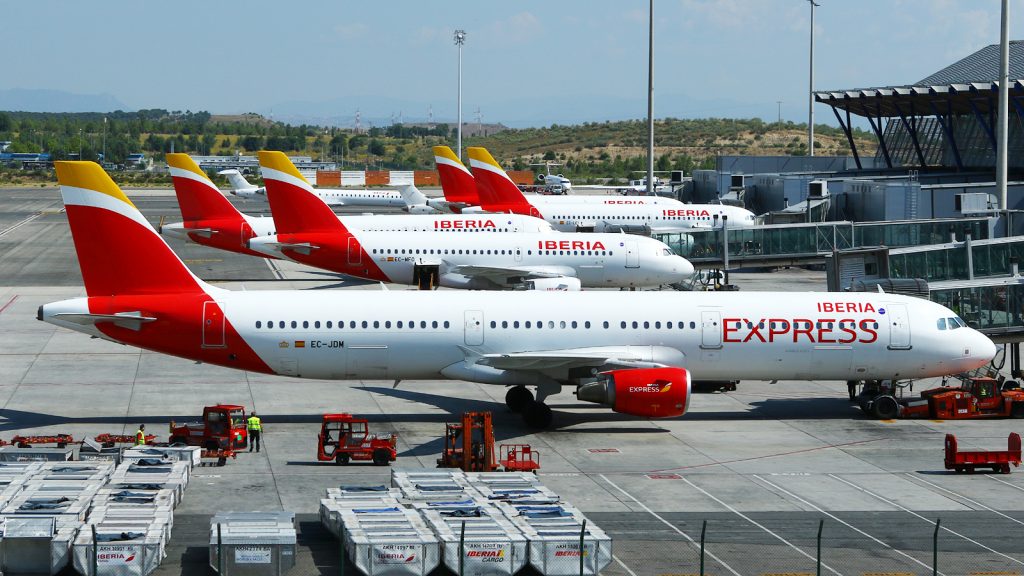
Photo (c) Erik Ritterbach
Madrid Barajas is vast — sprawling across the northeastern edge of the city. The airport features four runways (two parallel pairs) and multiple terminal areas, each with distinct roles.
The older Terminals 1, 2, and 3 handle many international and low-cost carriers, as well as some European flights operated by non-Iberia airlines. In contrast, Terminal 4 and its satellite, T4S, are dedicated primarily to Iberia and its Oneworld partners, including British Airways, American Airlines, Qatar Airways, and LATAM.
There is also a large maintenance base used by Iberia in the south east corner of the airfield. Airliners are often stored here for extended periods.
T4 is a masterpiece of design and efficiency. The main terminal serves Schengen flights, while the satellite building — linked by an underground automated people mover — handles long-haul and non-Schengen routes. For spotters, this terminal is a spectacle: a constant flow of Iberia red-and-yellow tails mixed with foreign widebodies from around the world.
Operations at Barajas run nearly 24 hours a day, with peak periods in the morning and late evening when Iberia’s connecting “banks” bring waves of flights from across Europe and send them onwards to Latin America, Africa, and North America.
Iberia: The Beating Heart of Barajas
It’s impossible to talk about Madrid Barajas without mentioning Iberia, the flag carrier of Spain. Founded in 1927, Iberia has grown alongside its home airport, and today it dominates operations at MAD.
Iberia’s network strategy revolves around Madrid as a connecting hub. The airline feeds short- and medium-haul traffic from across Europe and domestic Spanish cities into Madrid, where passengers connect to Iberia’s long-haul flights to the Americas.
Its fleet is one of the most modern in Europe, centered on Airbus A320-family aircraft for European routes and A330s and A350s for long-haul operations. Iberia has phased out older A340s, but for many years these graceful four-engine jets were a common sight at Barajas, particularly on South American services.
Through its membership in the Oneworld alliance, Iberia works closely with British Airways, American Airlines, and Qatar Airways, enhancing Madrid’s connectivity. Combined with its regional arm, Iberia Express, and its sister airline Air Nostrum, Iberia provides an extensive network unmatched by any other carrier in Spain.
Madrid’s Latin American Connection

Photo (c) Aero Icarus
One of the defining characteristics of Madrid Barajas is its deep connection with Latin America. Thanks to Spain’s historical, cultural, and linguistic ties, the airport serves as Europe’s primary bridge to the continent.
Dozens of daily flights link Madrid with cities across Central and South America. Iberia alone flies to more than a dozen destinations including Mexico City, Bogotá, Lima, Buenos Aires, Santiago de Chile, and São Paulo.
These routes are typically operated by the airline’s widebody Airbus A330s and A350s, but you’ll also see LATAM Airlines and Aeroméxico among the frequent visitors to T4S. This makes Madrid one of the few European airports where spotters can regularly see a lineup of Latin American liveries.
Beyond the Americas, Madrid also connects to long-haul destinations in Asia and Africa — including Tokyo, Doha, Johannesburg, and Nairobi — making it one of Europe’s most globally connected airports.
Spotting at Madrid Barajas

Emirates A380 landing at Madrid. Photo (c)
Ignacio Ferre Pérez
For plane spotters, Madrid Barajas is a dream destination. Its mix of heavy international traffic, strong Iberia presence, and excellent weather makes it ideal for photography and aircraft logging.
Here are some of the best vantage points:
- Near Terminal 4:
The elevated roads and parking areas near T4 offer good views of aircraft taxiing and departing. From the upper levels of the car parks, spotters can photograph widebodies at close range. - Mound:
One of the most popular spots at Madrid. Take the Metro to Barajas, the small town adjacent to the airport. Once there, walk along Av. De Logroño and turn left along Ctra. Cementerio Nuevo. Walk across the white pedestrian bridge and along to the raised area which allows you to log almost every movement, even aircraft using the distant new runway and Terminal 4. Photography is only really possible for aircraft passing on the taxiways nearer to you. It is possible to drive here if you follow signs for Barajas and then head towards the road tunnel under the airport. The mound is alongside this tunnel, with various places to park nearby. - Runway 32L/14R area (M-12 Road):
Along this stretch of highway, you’ll find several unofficial but popular viewing points. Morning light is excellent here for arrivals, especially for Iberia’s long-haul aircraft. - El Mirador de Barajas:
A public park and viewing area to the northwest of the airport offers panoramic views of both runways and approach paths. It’s one of the best-known official spots for enthusiasts. - T4 interior windows:
Inside the terminal itself, there are multiple large glass viewing areas where you can watch aircraft movements up close. Photography can be limited by reflections but still rewarding.

View from the Mound. Photo (c) Erik Ritterbach
Even at night, the constant flow of widebody departures — many bound for Latin America — keeps the action alive well past midnight.
The Competition and the Future

Photo (c) Gustavo H. Braga
While Barcelona El Prat has occasionally come close in total passenger numbers, Madrid consistently retains its crown as Spain’s busiest airport. It remains the primary intercontinental gateway and the home of Iberia’s global operations.
The future is bright: AENA continues to invest in infrastructure improvements, new taxiways, and digital systems to manage growing traffic. Plans are also in place for terminal refurbishments and sustainability initiatives to reduce emissions and noise.
And with Iberia expanding its fleet of Airbus A350s, plus new long-haul links on the horizon, Madrid Barajas will remain the centerpiece of Spanish aviation for decades to come.
World Airport Spotting Guides
If you want to find out more about spotting at Madrid Barajas, or other amazing airports across Spain and the rest of the world, check out our newly updated book written just for spotters. World Airport Spotting Guides features maps, descriptions and guides to hundreds of worldwide airports across 50 different countries.
Title image: Felix Kälin

