

Summary
Romania’s flag carrier TAROM is one of Europe’s oldest airlines, with a history stretching back more than a century through its predecessor companies. Once known for operating everything from Soviet-built airliners to Boeing 707s and Airbus A310s, today’s TAROM is a much smaller airline focused on connecting Bucharest with destinations across Europe and the Middle East.
However, the airline is at a crossroads. After years of financial losses and repeated restructuring attempts, TAROM is now working through a revised reorganisation plan agreed with the Romanian Government and the European Commission. The coming months could prove decisive in determining whether the airline can return to profitability and remain Romania’s national carrier.
Brief History of TAROM
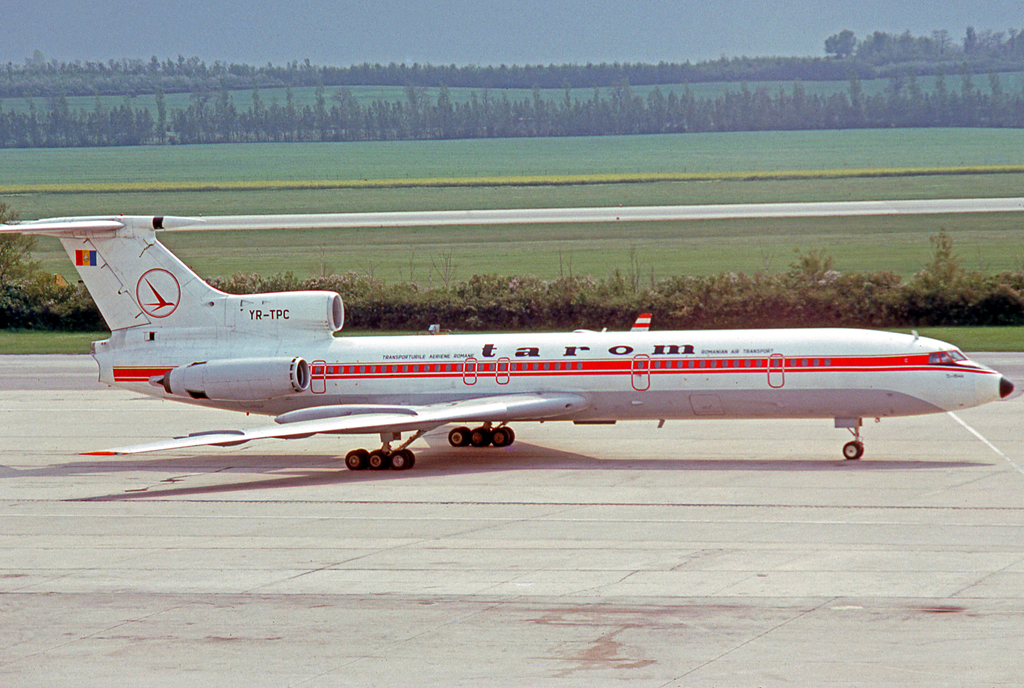
RuthAS, CC BY-SA 3.0 <https://creativecommons.org/licenses/by-sa/3.0>, via Wikimedia Commons
The origins of TAROM date back to 1920, when Franco-Romanian airline CFRNA (Compagnie Franco-Roumaine de Navigation Aérienne) was established. Following several reorganisations after the Second World War, the airline officially adopted the name TAROM (Transporturile Aeriene Române) on 18 September 1954.
During the Cold War, TAROM was unusual among European airlines in operating both Soviet and Western-built aircraft. Its fleet included the Antonov An-24, Ilyushin Il-18, Il-62 and Tupolev Tu-154 alongside BAC One-Elevens, Boeing 707s and later Airbus A310s.
By the 1970s and 1980s the airline operated an extensive international network reaching destinations throughout Europe, the Middle East, Africa and even North America and Asia. Scheduled flights to New York, Beijing, Bangkok, Chicago and Montreal demonstrated TAROM’s ambitions as a long-haul carrier.
The difficult economic conditions following the collapse of communism led to years of financial losses. During the early 2000s, the airline withdrew from long-haul flying, concentrating instead on shorter European routes.
In 2010, TAROM joined the SkyTeam alliance, strengthening its partnerships with airlines including Air France, KLM and Delta Air Lines.
Current Bases and Operations
TAROM’s main hub is:
- Bucharest Henri Coandă International Airport (OTP)
The airline also operates services from:
- Iași
- Cluj-Napoca
- Timișoara
Today, TAROM serves around 30 destinations across Europe and the Middle East, while also providing an important domestic network linking Romania’s regional cities with Bucharest.
Although considerably smaller than low-cost competitors such as Wizz Air and Ryanair in Romania, TAROM continues to play an important role by serving business travellers, government traffic and connecting passengers.
Fleet Overview

A TAROM ATR 72. Photo: Anna Zvereva
TAROM has been steadily simplifying and modernising its fleet as part of its restructuring programme. The airline is replacing older Boeing 737-700s with new-generation Boeing 737 MAX 8s while expanding its ATR 72-600 regional fleet.
Current Fleet
| Aircraft Type | In Service |
|---|---|
| ATR 72-500 | 2 |
| ATR 72-600 | 4 |
| Boeing 737-700 | 3 |
| Boeing 737-800 | 4 |
Aircraft on Order
| Aircraft Type | On Order |
|---|---|
| ATR 72-600 | 3 |
| Boeing 737 MAX 8 | 9 |
The arrival of the Boeing 737 MAX 8 fleet will eventually allow the retirement of the remaining 737-700s while improving fuel efficiency and reducing operating costs—one of the key aims of the airline’s restructuring programme.
Airline Livery
TAROM’s aircraft are among the easiest to recognise in Europe thanks to their elegant blue-and-white colour scheme.
The fuselage is predominantly white, with dark blue TAROM titles on the forward fuselage. A sweeping blue cheatline runs beneath the cabin windows before flowing into a deep blue tail featuring the airline’s iconic swallow logo, a symbol that has represented TAROM since 1954.
The engine nacelles are also painted dark blue, giving the fleet a clean and traditional appearance that has changed little over the past two decades.
Another interesting feature for enthusiasts is that every aircraft carries the name of a Romanian city, river or notable aviation pioneer.
Special Liveries
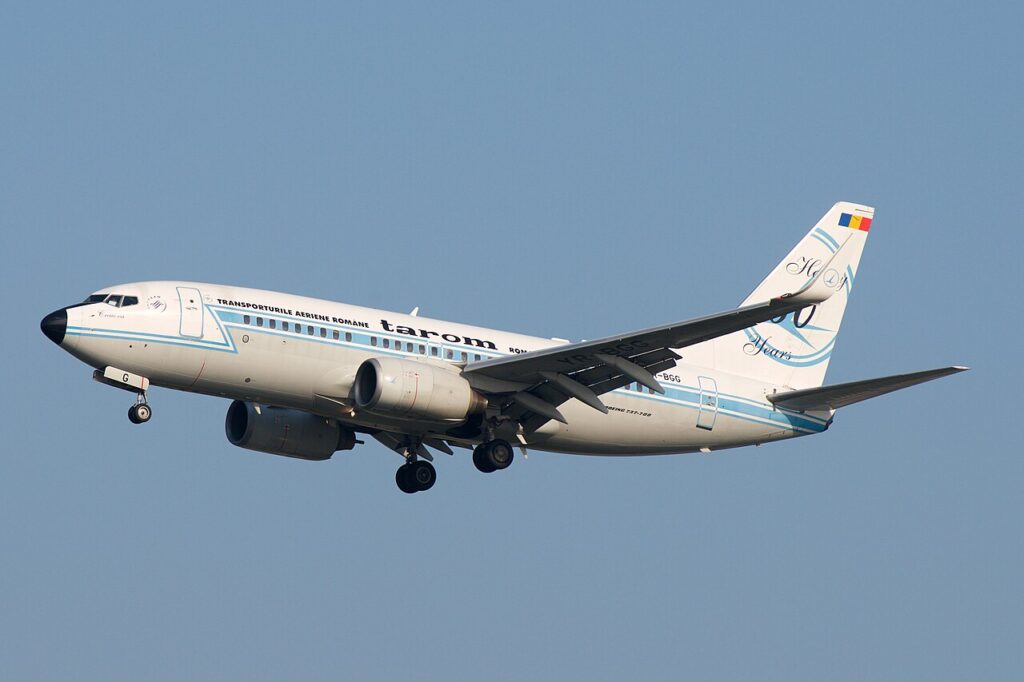
BriYYZ from Toronto, Canada, CC BY-SA 2.0 <https://creativecommons.org/licenses/by-sa/2.0>, via Wikimedia Commons
TAROM has generally preferred a uniform fleet appearance rather than operating numerous promotional liveries.
The best-known exception was a retro Boeing 737-700, painted in 2009 to celebrate the airline’s 55th anniversary. The aircraft wore colours inspired by TAROM’s 1950s livery, complete with a classic red cheatline reminiscent of the airline’s early piston-engine era.
Occasionally, individual aircraft have also carried temporary promotional decals for tourism campaigns or special anniversaries, although these have been relatively uncommon compared with many European airlines.
TAROM’s Future: Can the Airline Be Saved?
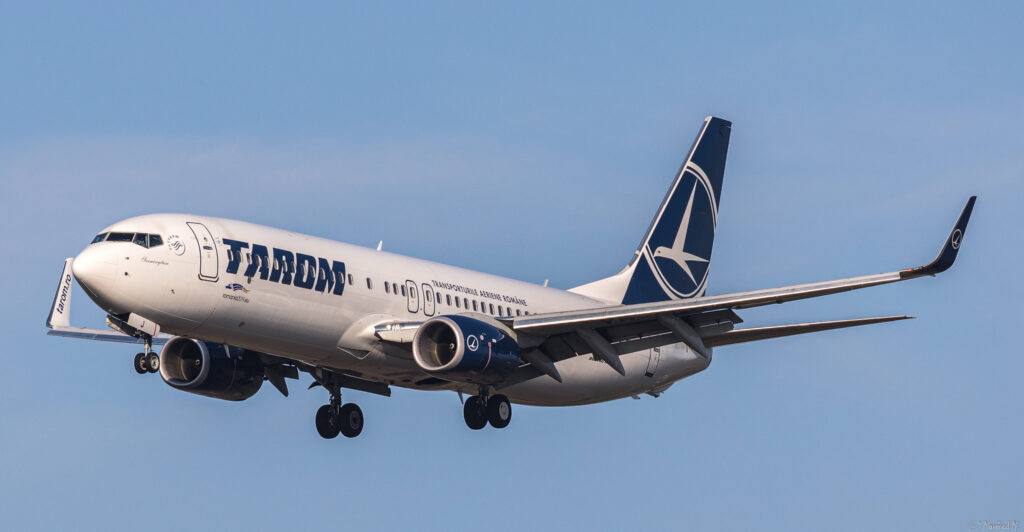
TAROM 737-800. Photo Manfred M
The biggest story surrounding TAROM today is not its fleet or route network, but its future.
The airline has not reported an operating profit for many years, and its survival currently depends on a restructuring programme backed by the Romanian Government and approved by the European Commission. That plan includes fleet simplification, route optimisation and significant cost reductions in exchange for state aid worth around €95 million.
However, by mid-2026 it had become clear that many of the programme’s financial targets would not be achieved on schedule. Romania’s new transport minister replaced the airline’s chief executive and announced that a revised restructuring plan would be submitted to the European Commission, arguing that higher fuel prices, aircraft delivery delays and changing market conditions had made the original timetable unrealistic.
The revised strategy is expected to focus on:
- Completing the transition to a modern Boeing 737 MAX fleet.
- Increasing passenger load factors through improved scheduling and marketing.
- Further reducing operating costs.
- Creating a financially sustainable airline capable of competing with low-cost carriers.
While the Romanian Government has made clear that it wants to preserve TAROM as the country’s national airline, success is far from guaranteed. If the revised plan fails to convince the European Commission that the airline can become viable, the state aid package could be withdrawn, placing TAROM’s future in serious doubt.
For enthusiasts, the coming years promise to be among the most significant in TAROM’s long history. Whether the airline emerges as a leaner, modern carrier built around the Boeing 737 MAX and ATR 72, or faces further uncertainty, its transformation will be one of Europe’s most closely watched airline turnaround stories.
Have you ever flown on TAROM? Leave a comment below!

