
Summary
When most people think of the Douglas DC-9 family, they picture the popular -30 series, the stretched -40s and -50s, or even the later MD-80s and MD-90s that evolved from the original design.
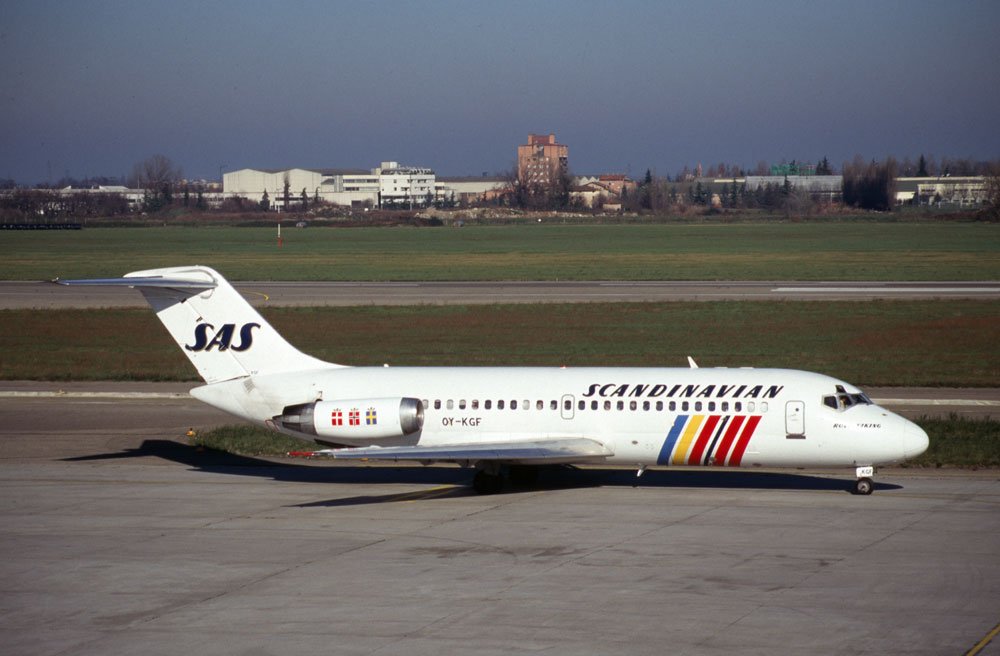
But tucked neatly into the family tree is a little-known outlier: the DC-9-21, a short-bodied, high-performance variant ordered and operated exclusively by Scandinavian Airlines System (SAS).
Only 10 aircraft were ever built. All of them went to SAS. And yet their unique capabilities make them one of the most fascinating footnotes in the DC-9 story.
This is how SAS helped design, launch and operate one of the rarest jetliners of the jet age.
Why SAS Needed a Different DC-9
Eduard Marmet, CC BY-SA 3.0 GFDL 1.2, via Wikimedia Commons
In the mid-1960s, SAS had a problem most airlines would envy: enormous seasonal swings in traffic.
Scandinavia’s travel patterns weren’t consistent year-round. Winter flying in Norway and northern Sweden involved short runways, steep approaches, icy conditions and challenging airport environments. Summer schedules were busier, but winter needed power and agility, not capacity.
The standard DC-9-30 was too big and heavy for certain regional routes. The DC-9-10 had the shorter fuselage but lacked the takeoff performance needed for SAS’s demanding northern network.
SAS wanted an aircraft that combined:
-
the short fuselage and lighter weight of the DC-9-10/14/15,
-
the more powerful engines and wing improvements of the DC-9-30,
-
and the ability to operate from short, icy Scandinavian runways.
Douglas listened — and the DC-9-21 was born.
What Made the DC-9-21 Unique?
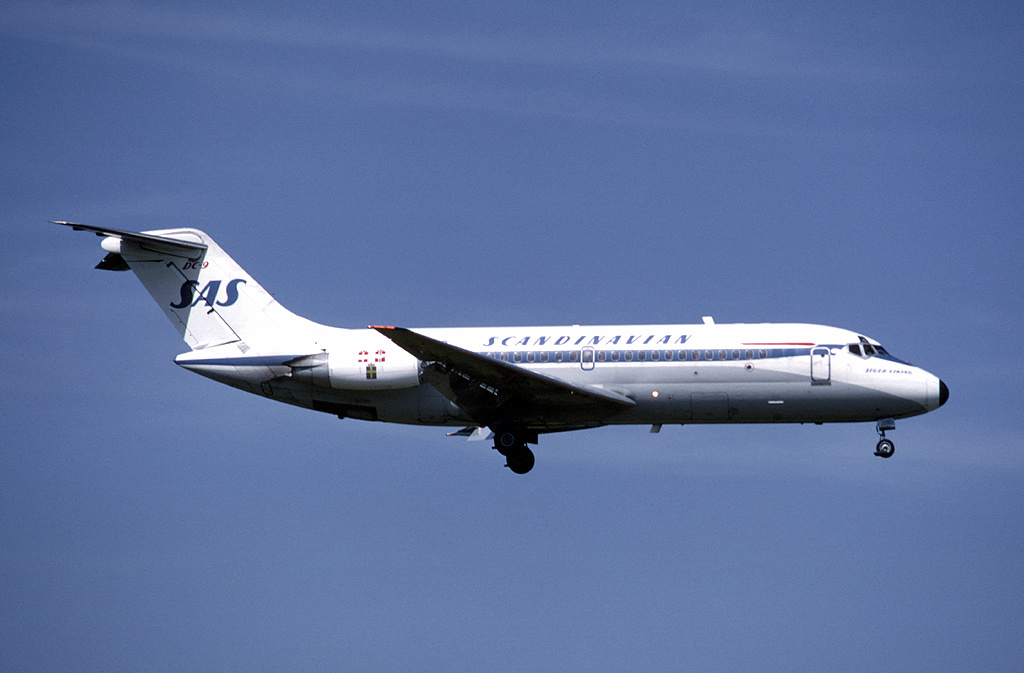
To create the -21, Douglas essentially took the fuselage of a DC-9-10 and mounted it onto the strengthened wing and landing gear of a DC-9-30. The result was a compact, rocket-like airliner optimised for short-field and cold-weather performance.
Key characteristics included:
🔹 Shorter fuselage (the -10 body)
Just 89 feet long, making it highly responsive and perfect for operating into small airports.
🔹 More powerful JT8D-7 engines (from the -30)
Providing superior thrust for short runways and high-density altitude operations.
🔹 Higher maximum takeoff weight
Thanks to the -30’s reinforced wing and landing gear.
🔹 Improved low-speed handling
Ideal for the short approaches common across northern Norway.
🔹 Steep climb capability
Perfect for terrain-heavy regions and harsh winter weather.
The aircraft could seat fewer passengers than the -30 or -40, but SAS wasn’t concerned with capacity — it needed performance.
Entry Into Service — and a Short Production Run

Eduard Marmet, CC BY-SA 3.0 GFDL 1.2, via Wikimedia Commons
The DC-9-21 made its debut with SAS in 1968, entering service across the carrier’s Scandinavian and northern European network.
Only 10 were ever built, all delivered between 1968 and early 1969. No other airline ordered the variant, making it one of the rarest production jetliners in history.
How SAS Used the DC-9-21
The -21 quickly established itself as a workhorse for short, challenging Scandinavian routes. SAS deployed it across:
-
Norway’s rugged regional airports
-
Short-haul services to Denmark and Sweden
-
Arctic routes with difficult weather conditions
-
Lower-demand European flights where the DC-9-30 was too large
Airports like Bodø, Tromsø, Kiruna, and others in the far north were exactly the kind of places the DC-9-21 excelled. Its short-field capability allowed SAS to maintain reliable jet service in regions that had previously relied on turboprops or piston aircraft.
In many ways, the -21 was the perfect “Scandinavian jet” — small, powerful, resilient and capable of handling winter conditions better than many contemporary competitors.

Some SAS DC-9-21s went on to fly for ValuJet. Photo (c) Aero Icarus
By the late 1980s, SAS began standardising its fleet with larger DC-9-30s, -40s and -50s, and eventually MD-80s. However, the last of the DC-9-21s soldiered on with some gradually retired or sold, and the last being retired in 2000.
Some went on to fly for ValuJet Airlines and Spirit Airlines in the United States.
The Last Flying DC-9-21: Skydive Perris’s Jump Ship
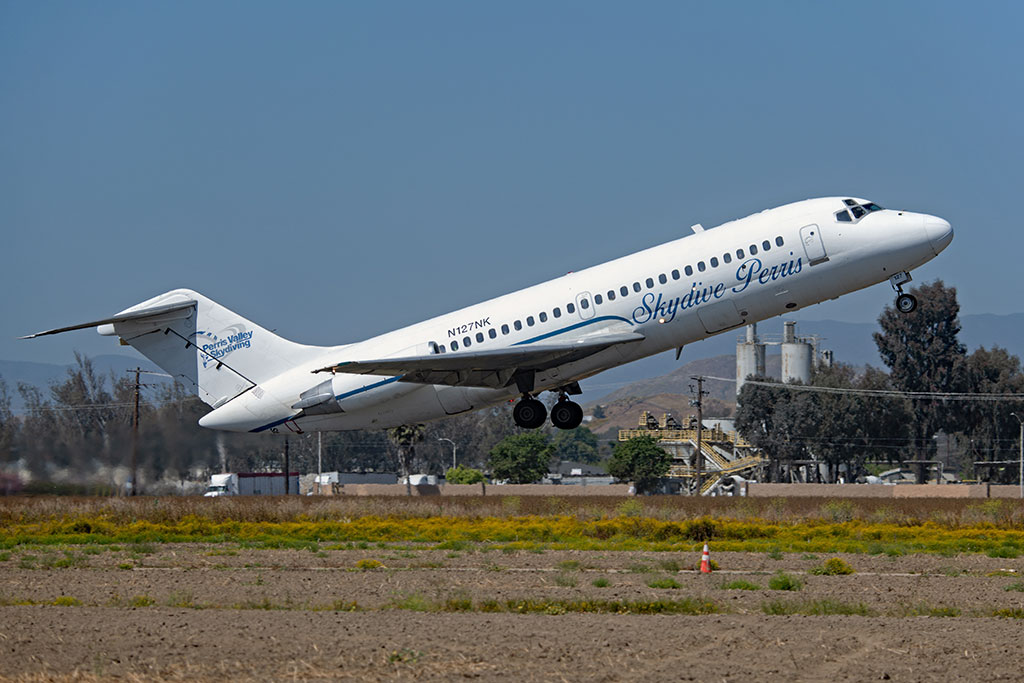
Photo (c) Dan Stijovich
Although the DC-9-21 disappeared from airline schedules decades ago, one airframe lives on today in a very different role — airborne sports.
The final operational DC-9-21 in the world is N127NK (previousld SE-DBO), operated by Skydive Perris in California.
Instead of flying passengers across Scandinavia, it now acts as a high-altitude jump platform for skydivers and world-record parachute teams.
With its powerful engines and quick climb capability — the same traits SAS needed for icy runways — the -21 has found new life launching skydivers over the Mojave Desert.
Spotters at Perris Valley Airport can still hear the unmistakable roar of a DC-9 taking off — a sound that has all but vanished from the world’s passenger airports.
A Rare Variant with a Remarkable Story
The Douglas DC-9 line produced more than 976 aircraft, but the -21 remains the rarest major variant — a bespoke jet built for one airline’s unique operational needs.
SAS didn’t just operate the -21; they shaped it, helping Douglas create a specialised performance machine ahead of its time.
And while almost all of them are gone, one example continues to climb, roar and fly — a living reminder of the era when airlines could request custom-built jets for their networks.
If you ever find yourself in Southern California, keep an eye (and ear!) on the skies over Perris — you may just catch the world’s last DC-9-21 still earning its keep.
Did you ever fly on a DC-9-21? Leave a comment below!


5 comments
[…] Source: https://www.airportspotting.com/how-sas-pioneered-the-dc-9-21/ […]
Flown the DC 9 for 25 years for SAS – 12.700 hours total and many of those on the DC 9/21.
Wow, fantastic! I bet you had some great experiences!
This was the first jet I flew, as a kid, it started the jet age for passengers in the high north of Norway, a revolution. Onboard the DC-9-21 we experienced the thrill of jet travel, the great SAS service and indeed some turbulent winter flights!
Managed to fly on the DC-9-15 G-BMAB of British Midland BFS/LGW in 1981 !
Smallest DC-9 I have flown on .