

Summary
For decades, the Boeing 757 was the backbone of Icelandair’s fleet, perfectly suited to the airline’s unique position as a transatlantic connector between North America and Europe. But times are changing. In 2025, Icelandair began introducing a new aircraft that is gradually transforming its route network and fleet structure: the Airbus A321LR.
The arrival of this modern, fuel-efficient narrowbody marks the start of a new era—not just for Icelandair, but for how long-haul, low-demand routes are flown. And for plane spotters and aviation fans, it offers a rare glimpse at how a legacy aircraft type is being gracefully phased out in favour of something leaner, greener, and just as capable.
From Boeing to Airbus
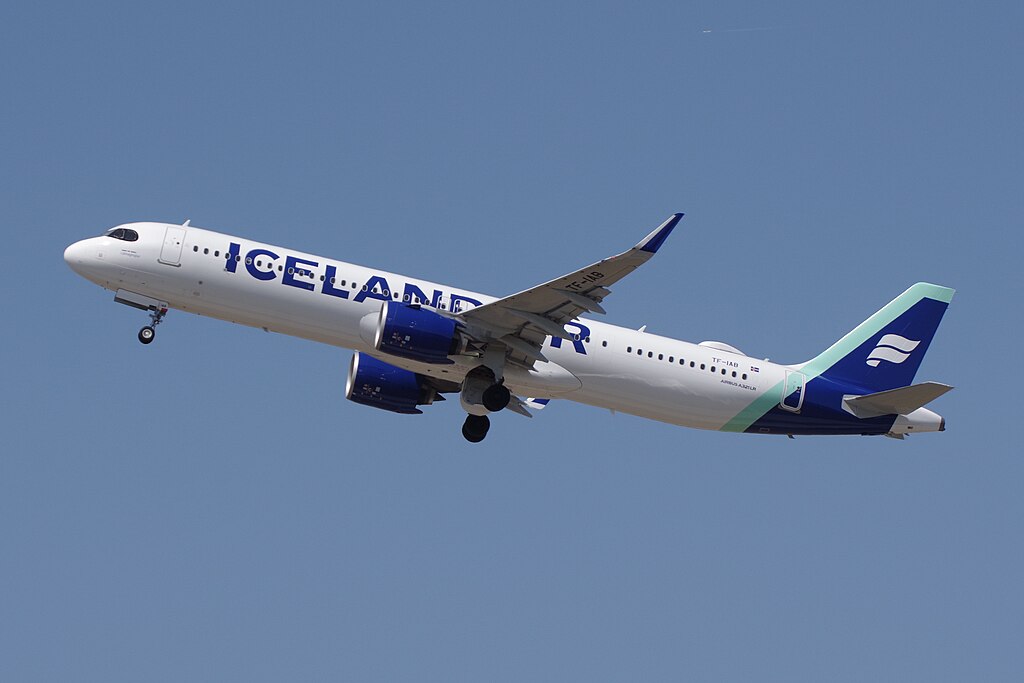
André Gerwing, CC BY-SA 4.0 <https://creativecommons.org/licenses/by-sa/4.0>, via Wikimedia Commons
Icelandair took delivery of its first Airbus A321LR in December 2024, marking the airline’s first ever Airbus aircraft. By mid-2025, four A321LRs are in service, operating a mix of European and transatlantic routes. These aircraft were brought in to gradually replace the aging Boeing 757 fleet, which has served the airline reliably since the early 2000s.
Unlike the 757, which has long been praised for its performance and range, the A321LR brings the benefits of a modern airframe: improved fuel efficiency, a quieter cabin, and better economics. For passengers, the aircraft features Airbus’ latest Airspace cabin design, complete with larger overhead bins, ambient lighting, and a more spacious feel—essential for flights of up to 8 hours.
Icelandair has also introduced the Boeing 737 MAX in recent years, which is another modern airliner that will operate alongside the A321 fleet.
Where Icelandair is Flying the A321LR

Photo: Icelandair
Icelandair has begun deploying the A321LR on several routes, allowing for more efficient operations and new city connections:
From Winter 2024–25
-
Initial services included Reykjavik (KEF) to Copenhagen (CPH) and Stockholm (ARN), both launched from December 10, 2024.
-
Shortly after, flights to London (LHR) (Dec 23) and Oslo (OSL) (Dec 24) were introduced.
Spring–Summer 2025 Expansion
-
Manchester (MAN) arrives April 2025, Glasgow (GLA) in May, plus rotating services to Amsterdam (AMS) and Brussels (BRU).
Planned North American Deployments
-
According to aeroroutes data, the A321LR is slated to launch Reykjavik–Miami, Newark, New York–JFK, Orlando, and Portland in 2025/26, with Miami service beginning January 6, 2026.
-
Business Insider notes A321LR flights to Seattle, Toronto, and Portland—routes up to eight hours.
A notable example is the Reykjavik–Miami route, which will see A321LR service beginning in January 2026—a sector of nearly 4,000 nautical miles. It’s the kind of route that demonstrates the aircraft’s flexibility and long-range credentials, especially from a northern gateway like Iceland.
The Bigger Picture: A321XLR on the Horizon
While the A321LR is already reshaping Icelandair’s network, the bigger transformation will come with the arrival of the even longer-range Airbus A321XLR. Icelandair has 13 of these aircraft on order, with deliveries scheduled to begin in 2029.
The XLR offers an extended range of up to 4,700 nautical miles, meaning Icelandair will be able to serve deeper into North America—potentially opening up cities like Houston, Atlanta, and even the US West Coast with greater regularity. The XLR will also enable year-round service to thinner markets that aren’t viable for larger widebodies.
Combined with the A321LRs already in service, the future Airbus fleet will allow Icelandair to operate a more efficient hub-and-spoke model via Reykjavik, connecting passengers between Europe and North America with optimal aircraft for each route.
A New Era for Icelandair—and for Spotters

The outgoing Icelandair Boeing 757 fleet. Photo (c) Andy Pope
The transition from Boeing 757 to Airbus A321LR/XLR isn’t just a change in equipment—it represents a shift in Icelandair’s strategy. The flexibility and efficiency of these aircraft will allow the airline to adjust capacity, open new markets, and reduce its environmental footprint, all while maintaining its unique geographic advantage.
For aviation enthusiasts, it’s also a bittersweet moment. The 757 has long been a favourite for its performance, appearance, and role in connecting secondary cities across the Atlantic. But the A321LR is quickly earning its place as a worthy successor—both in the skies over Iceland and at airports on both sides of the Atlantic.
If you’re planning a trip to Reykjavik soon, keep an eye out: the A321LR is now a regular feature at Keflavik, and its presence is only set to grow in the coming years.
You can book Icelandair flights here.