
Summary
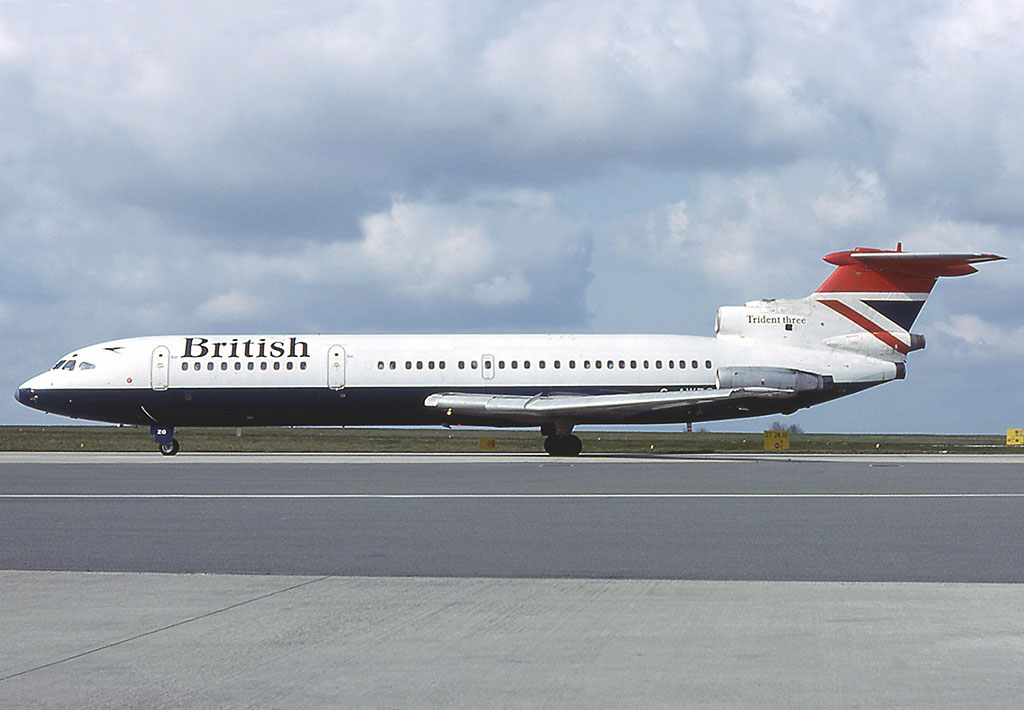
On 31 December 1985, a quiet but significant moment in British aviation history took place. Two Hawker Siddeley HS.121 Tridents made the final commercial landings in the UK of the type, closing the chapter on more than two decades of service for a jet that was once among the most technically advanced airliners in the world.
Forty years later, the Trident remains a symbol of Britain’s early jet-age ambition — a pioneering tri-jet packed with innovations, yet ultimately overshadowed by more commercially successful rivals like the Boeing 727.
This is the story of the Trident’s rise, its modest production, its final flights in the UK, and the unexpected afterlife it enjoyed thousands of miles away.
A British Tri-Jet Ahead of Its Time
The Trident was designed by de Havilland (later Hawker Siddeley) in the late 1950s as a fast, sleek, short-to-medium-haul jet tailored specifically for British European Airways (BEA).
Even if the aircraft did not become a global bestseller, its technology was remarkable. The Trident was the world’s first airliner with a fully automatic blind landing system — an innovation that gave it unmatched low-visibility performance and shaped modern autopilot design.
The aircraft featured:
- A distinctive three-engine rear-mounted layout
- A T-tail
- Advanced avionics
- A surprisingly high cruising speed that could rival larger long-haul jets
Yet the Trident’s capabilities were also its limitation: BEA’s insistence on a smaller, lighter design led to an aircraft perfectly suited to its network but less attractive to overseas buyers.
The Variants: Trident 1, 2, 3 & 4-Engine Version
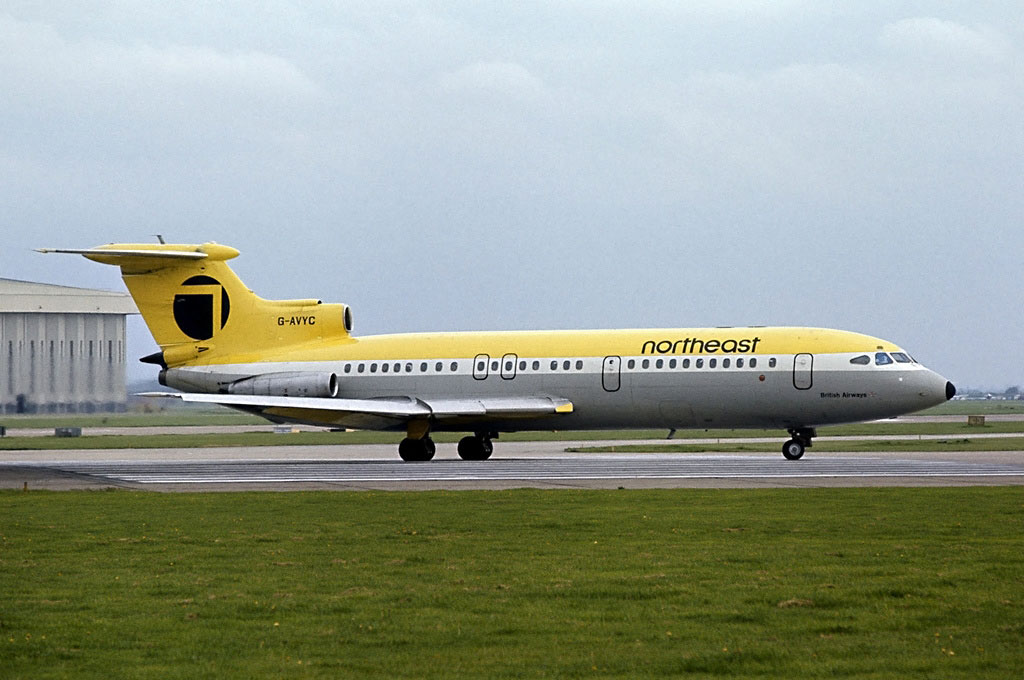
Hawker Siddeley Trident 1E, G-AVYC, of Northeast Airlines (Photo: Steve Fitzgerald, distributed under a GFDL 1.2 Licence)
Across the family line, 117 Tridents were built — a relatively low number for a jet of its era.
Trident 1C
The original variant, entering service in 1964, was optimised for BEA’s European network. The Trident 1E was an export version.
Trident 2E
Introduced extra fuel tanks and more powerful engines, expanding its range and making it more competitive.
Trident 3B
The most visually distinctive model, fitted with a fourth “boost” engine — a small Rolls-Royce RB162 turbojet mounted at the base of the tail — to improve take-off performance from shorter runways.
This quirky four-engine tri-jet became the dominant version in BEA and later British Airways fleets.
Despite these developments, the aircraft struggled internationally. While the Boeing 727 sold over 1,800 units, the Trident secured only 117 — an enormous contrast in commercial success.
Service Life in the UK — A Workhorse for BEA and British Airways
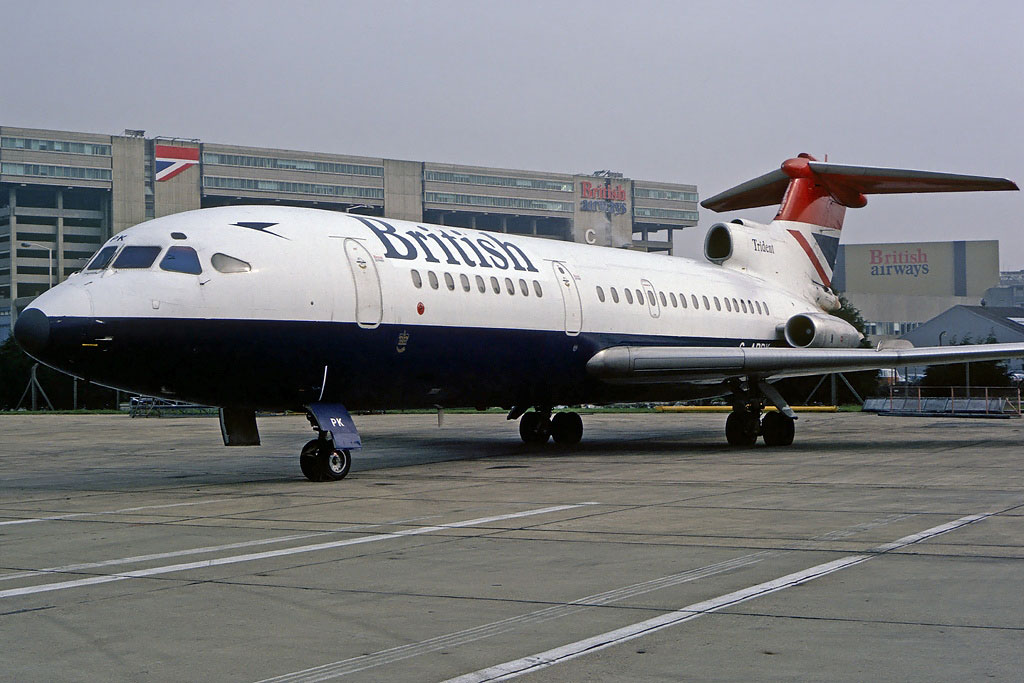
Hawker Siddeley Trident 1C, G-ARPK, at London Heathrow (Photo: Steve Fitzgerald, distributed under a GFDL 1.2 Licence)
Throughout the 1960s and 70s, the Trident was the backbone of BEA’s European operations. It flew high-frequency shuttle routes to Paris, Brussels, Frankfurt, Copenhagen and across the UK domestic network.
After the formation of British Airways in 1974, the Trident continued in service for another decade, increasingly displaced by the Boeing 737, 757 and BAC One-Eleven fleets.
By the mid-1980s, it had become clear that the Trident — with its older engines and dated flight deck — was nearing retirement.
31 December 1985 — The Final Flights

The last commercial Trident services in the UK took place on 31 December 1985, marking the end of an era.
British Airways operated some farewell flights, with many aviation enthusiasts turning out to watch the final departures and landings of a jet that had defined Britain’s short-haul travel for more than 20 years.
Two flights (one a scheduled service from Amsterdam and the other an enthusiasts’ charter from Manchester) were scheduled to land simultaneously at London Heathrow, flown by G-AWZU and G-AWZO respectively. When the final set of wheels touched down that afternoon, the Trident disappeared from scheduled British skies forever — closing a chapter that began with great promise in the 1960s.
[Read: Classic Airline Fleets – BEA’s Tridents]
A Second Life in China — Long After the UK Retired Them
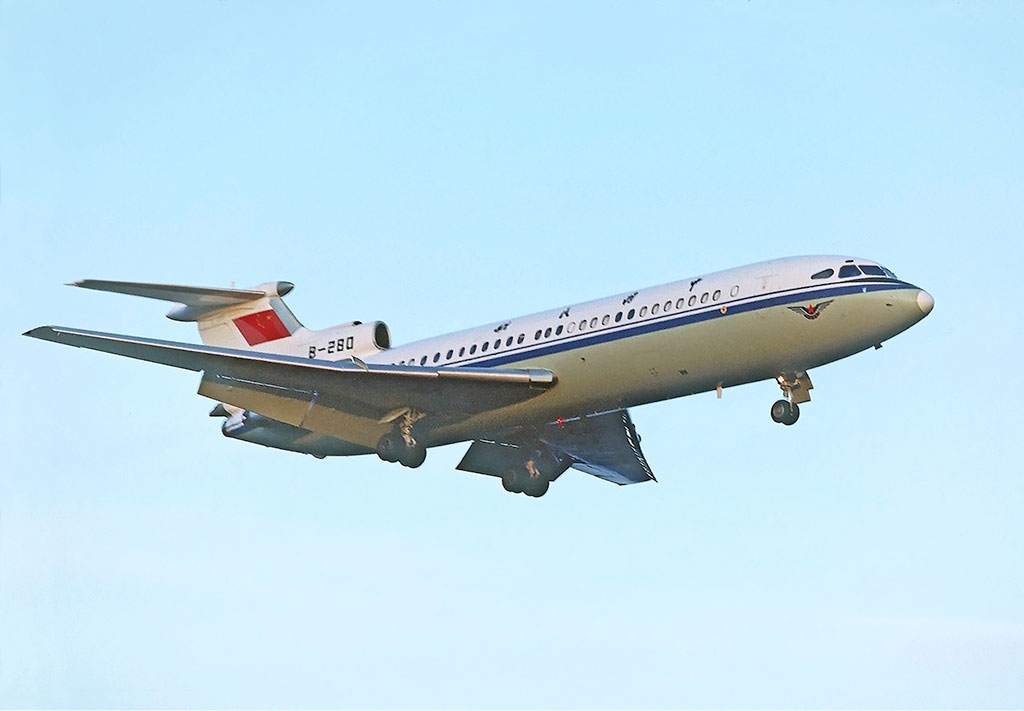
Hawker Siddeley Trident 2E, B-280, of the Civil Aviation Administration of China (CAAC) (Photo: Lars Söderström, distributed under a CC BY-SA 3.0 Licence)
Although retired in the UK, the Trident story continued far from Europe.
China purchased numerous Tridents in the 1970s, operating them with CAAC (the Civil Aviation Administration of China) and later local carriers such as China United Airlines.
Remarkably, the Trident remained active in China until around 1995, extending the operational life of an aircraft that, in Britain, had faded a decade earlier.
China’s extensive use of the Trident helped keep many airframes flying far longer than expected, and created an unusual legacy: more people in China flew on a Trident in the late 80s and early 90s than ever did in Europe during the same period.
Some former British Airways Tridents were also sold to Air Charter Services (ACS) in Zaire where they enjoyed a brief service life, and the sole Air Ceylon example also flew into the late 1980s.
Where You Can See a Trident Today

A Trident 2E on display at Duxford, UK.
Although no Trident flies today, several examples survive in museums — a fortunate outcome for such a relatively small production run.
In the UK
You can visit preserved Tridents at:
- The Imperial War Museum Duxford (Trident 2E G-AVFB)
- Runway Visitor Park, Manchester Airport (Trident 3B G-AWZK)
- North East Land, Sea & Air Museums, Sunderland (Trident 1C G-ARPO)
- Other smaller aviation collections where fuselage sections or cockpits are preserved
In China
A number of Tridents remain preserved or displayed at aviation technical schools, museums, and air force bases.
The Trident may never have matched the sales numbers of the Boeing 727, but it remains a classic of British engineering — bold, advanced, and unlike anything else in the sky.
Four decades on, we still remember the day their engines fell silent over Heathrow. Do you remember seeing them lined up at London Heathrow, or did you ever fly on one? Leave a comment below!



5 comments
a quick review of online imagery shows the following:
The Imperial War Museum Duxford (Trident 2E G-AVFB) is preserved in the BEA delivery livery (Red Square / de Saulles) and is currently the only fully intact example of a Trident in the UK. As with most of the aircraft on outside display at Duxford the interior is open during select events.
Runway Visitor Park, Manchester Airport (Trident 3B G-AWZK) is preserved in the final BEA livery (Speedjack / FHK Henrion) and has air stairs in place for both forward port doors indicating the possibility of viewing the interior. Approximately 2m of both wings have been chopped off.
North East Land, Sea & Air Museums, Sunderland (Trident 1C G-ARPO) is preserved in the final North East livery of 1970; the fuselage is intact with air stairs and is open for visitation on an unknown schedule. The wings and tail units are stored on the grounds awaiting restoration.
[…] Source: https://www.airportspotting.com/40-years-since-tridents-last-flew-in-the-uk/ […]
Yes, flew on at least one between Heathrow and Inverness in the early 1980’s. I sat in the smoking section! I don’t really remember much else.
I had 34 Trident flights on all three models , amazingly my first flight was on G-ARPA and my last on G-AWZZ! Great aircraft indeed , loved them .Have been through WZK at MAN and VFB at Duxford and RPH when it was at Cosford many years ago
if I’m not mistaken 5B-DAB remains at old the Nicosia Airport in Cyprus , not in good condition though