

The Douglas DC-9 is best remembered as a short-haul commercial airliner, buzzing around the United States and Europe throughout the 1960s, 70s and 80s. But the type also played a surprisingly significant role in U.S. military aviation, serving for decades in medical transport, VIP travel and personnel movement.
Two specialised variants were developed for the U.S. Air Force and Navy: the C-9A “Nightingale”, optimised for aeromedical evacuation, and the VC-9C, used for flying senior government officials — including, at times, the Vice President and First Lady.
Though no military DC-9s remain in active service in the US today, the fleet enjoyed a remarkably long career and left a deep legacy in military transport history.
The DC-9 Enters Military Service
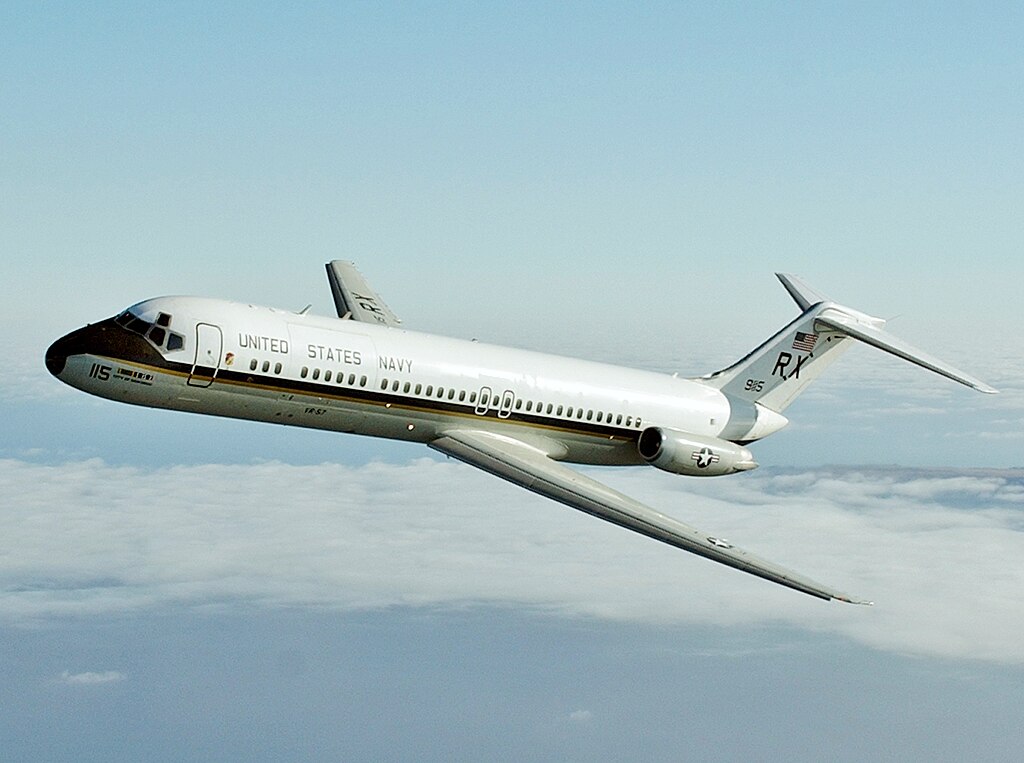
030819-N-6501M-017
San Diego, Calif. (August 19, 2003) — A C-9B Skytrain II from the “Conquistadors” of Fleet Logistics Squadron FIVE SEVEN (VR 57) flies over the Pacific Ocean during a routine training flight.
US Navy Photo by Photographer’s Mate First Class Edward G. Martens
The U.S. Air Force evaluated several commercial aircraft in the late 1960s for the growing requirement of dedicated aeromedical evacuation. Helicopters and cargo aircraft could perform medevac missions, but none had the speed, comfort or altitude capability needed to transport patients between medical facilities across the country or internationally.
The DC-9, with its reliable JT8D engines, low operating costs and comfortable pressurised cabin, was the ideal platform.
Two derivatives were ordered:
- C-9A Nightingale – aeromedical evacuation (USAF)
- C-9B Skytrain II – personnel/cargo transport (US Navy & Marine Corps)
- VC-9C – VIP special mission transport (USAF)
Each was modified to meet military needs, but the -21’s legacy of specialised performance lived on indirectly here: Douglas demonstrated with SAS that customised DC-9 variants were both feasible and practical.
C-9A “Nightingale” — The Flying Hospital

A Douglas C-9A Nightingale. Photo (c) Dick Gilbert
Role: Aeromedical evacuation
Entered service: 1968
Total built: 21 for the USAF
The C-9A Nightingale was designed from the start as a flying hospital ward. The aircraft featured:
- Large medical doors for loading stretchers
- Litter stations for up to 40 patients
- Six medical oxygen systems
- Special lighting, including “white-out” for patient comfort
- Nurse call systems
- Medical refrigeration and storage
The aircraft became a backbone of U.S. medevac operations, transporting wounded soldiers, injured civilians, and high-dependency patients between military hospitals.
C-9As saw extensive service during:
- Vietnam War medical evacuations
- Persian Gulf and Desert Storm patient transports
- Routine global medevac missions between US bases in Europe, Asia and the mainland
The Nightingale remained in service until 2005, when it was gradually replaced by newer platforms such as the C-17, KC-135 and later the Gulfstream C-37.
By 2011 the final C-9A had retired, ending more than 40 years of continuous service.
VC-9C — VIP Transport for Washington’s Elite
Role: Executive transport (Presidential support fleet)
Entered service: 1975
Total built: 3 for the USAF
The VC-9C was a highly customised DC-9-30 used for flying:
- The Vice President of the United States
- The First Lady
- Senior Cabinet officials
- Congressional delegations
- Diplomatic missions
Although these aircraft never carried the President himself on long-haul missions, they were part of the presidential support fleet — and when carrying the Vice President, they operated under the callsign “Air Force Two.”
The VC-9C cabin included:
- A VIP lounge
- Secure communications systems
- Specialised seating configurations
- Enhanced soundproofing
- Upgraded avionics
Two of the VC-9Cs served at Joint Base Andrews (alongside the 707-based VC-137 fleet), and one flew from Scott Air Force Base.
The type was retired in 2005, but continues to appear in photos at aviation museums across the United States.
C-9B Skytrain II — US Navy & Marine Corps Workhorse
While technically a U.S. Navy/USMC aircraft, the C-9B deserves mention for its long and visible career.
Role: Passenger & cargo transport
Entered service: 1973
Total built: 24
The Skytrain II provided regional transport for military personnel, equipment and mail. It served from Sicily to Japan, and throughout the U.S., often flying between naval air stations.
The Navy and Marine Corps finally retired their last examples in 2014.
Are Any Still Flying Today?

Preserved Douglas C-9 at Pima Air & Space Museum. Photo (c) Pete Webber
Most military DC-9 derivatives have been phased out, but a small number survive:
Still active (limited):
- Some C-9B Skytrain II aircraft remained operational in training and logistics roles outside the U.S. for a few years beyond their U.S. retirement.
- A handful remain stored in Arizona at AMARG.
Preserved:
- Several C-9As and VC-9Cs are on display at U.S. aviation museums, including the Air Mobility Command Museum and the Pima Air & Space Museum.
Commercial survivors:
- No DC-9 military variants are in active U.S. service today.
- The standard DC-9 family continues in limited use worldwide (including the unique DC-9-21 with Skydive Perris).
Title image: Aktug Ates (GFDL 1.2 <http://www.gnu.org/licenses/old-licenses/fdl-1.2.html> or GFDL 1.2 <http://www.gnu.org/licenses/old-licenses/fdl-1.2.html>), via Wikimedia Commons



2 comments
[…] Source: https://www.airportspotting.com/how-the-us-air-force-used-the-douglas-dc-9/ […]
Have photographed a number of USAF and USN DC-9s over the years, always good to see.