

Summary
Seaplanes and amphibious aircraft are some of the most fascinating machines in aviation. Long before jetliners dominated the skies, flying boats connected continents and remote islands. Today, these unique aircraft still play a vital role — and for aviation enthusiasts, they offer some of the most photogenic and memorable spotting opportunities.
Here’s your guide to spotting seaplanes and amphibious aircraft around the world.
What Makes Seaplanes Special?
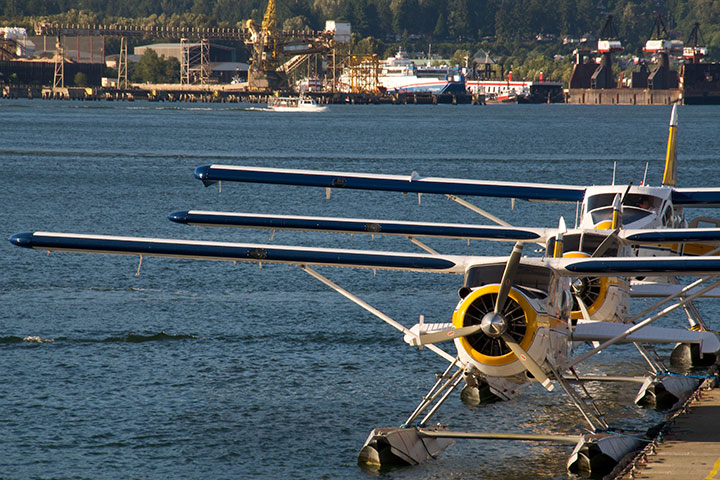
Seaplanes in Vancouver Harbour. By Brian (Flickr: Harbour Air) [CC BY-SA 2.0 (http://creativecommons.org/licenses/by-sa/2.0)], via Wikimedia Commons
For spotters, they stand out for their unusual shapes:
- Large hulls or floats for buoyancy.
- High wings for clearance above the water.
- Often dramatic settings — lakes, harbors, and remote islands instead of busy airports.
There are also many light aircraft operating in the general aviation world that fly on water, particularly in remote locations like Alaska and Canada.
Key Types Still Flying

Trans Maldivian Twin Otters. TMAShahid, CC BY-SA 4.0 <https://creativecommons.org/licenses/by-sa/4.0>, via Wikimedia Commons
Interestingly, there have been relatively few new floatplane types developed in recent years. However, most of the classic types are rugged and long-lasting, and live on.
These are some of the more common types you’ll see.
- De Havilland Canada DHC-2 Beaver & DHC-3 Otter – rugged bush planes, still common in Alaska and Canada.
- Cessna Caravan on floats – a modern workhorse for short hops in the Maldives, Caribbean, and Pacific.
- Bombardier CL-415 & Beriev Be-200 – amphibious water bombers, often seen in southern Europe during wildfire season.
- Vintage PBY Catalinas – rare survivors at airshows and museums, a treat for historic aviation fans.
- De Havilland Canada DHC-6 Twin Otter – often used to carry more passengers to island locations, such as in the Maldives.
Top Global Seaplane Spotting Locations

Lake Hood – the world’s busiest seaplane base. Photo (c) Timothy Wildey
Vancouver Harbour, Canada
Home to Harbour Air, the world’s largest seaplane airline. Constant DHC-2 Beaver and Twin Otter movements make it a paradise for spotters.
Lake Hood, Anchorage, Alaska
You won’t find airline flights here, but Lake Hood is the world’s busiest seaplane base. Located right next to Ted Stevens Anchorage International Airport, it is a hive of activity with smaller floatplanes coming and going all day long. These are used for pleasure, and for venturing into the wild interior of Alaska.
Malé, Maldives
One of the busiest seaplane airports in the world, with Trans Maldivian Airways operating many flights daily using Twin Otters.
Juneau & Anchorage, Alaska
Busy harbors full of Beavers, Otters, and Caravans serving remote communities.
Sydney, Australia
Sydney Seaplanes operate from Rose Bay, offering incredible photo opportunities with the Harbour Bridge and Opera House as backdrops.
Lake Como, Italy
One of Europe’s few remaining seaplane bases, operated by Aero Club Como. A picturesque spot for vintage and modern floatplanes.
Spotting Amphibious Aircraft

CL-215 and other amphibious aircraft.
Don’t forget the water bombers! Amphibious types like the CL-415 are regularly deployed in southern France, Spain, Greece, and Italy during wildfire season. Spotters can often catch them scooping water from lakes or coastlines before roaring off on another firefighting sortie.
Why Seaplane Spotting Is Different

╚ DD╔ from Male, Maldives, CC BY-SA 2.0 <https://creativecommons.org/licenses/by-sa/2.0>, via Wikimedia Commons
Seaplanes and floatplanes are, in many ways, just the same as any other aircraft to spotters. They carry a registration or serial to log, and can be photographed just the same. However, there are some other considerations:
- Locations are often more relaxed and scenic than big airports, with fewer boundary fences to get in the way!
- Aircraft movements can be unpredictable — many are charter or weather-dependent.
- Photography rewards include dramatic reflections on the water and iconic city or island backdrops.
Take the Plunge
Whether it’s the bustling docks of Vancouver, the turquoise waters of the Maldives, or the Mediterranean coastline during firefighting season, seaplanes bring a unique dimension to aviation spotting. They connect places no jetliner can reach — and for enthusiasts, they provide some of the most exciting and photogenic opportunities worldwide.
Have you ever flown on a seaplane? Leave a comment below!
Title image: By Jonathan Palombo – 8Q-MBE, CC BY 2.0, https://commons.wikimedia.org/w/index.php?curid=37800613



5 comments
Another fantastic spot is Juneau Alaska as the seaplanes takeoff with a backdrop of some of the worlds largest cruise ships.
I have flown in a Beaver around San Francisco harbour and previously flew in a Chalks Mallard to/from Bimini from Miami Watson Island
A good European option is the seasonal Copenhagen to Aaarhus seaplane service with Twin Otters.
Copenhagen to aarhus on the seasonal service with Twin Otters is a good European option.
I really enjoyed taking an evening sightseeing flight with Nordic Seaplanes over Copenhagen back in August 2022.