

Summary
Brightly painted aircraft in shades of pink, turquoise, and yellow aren’t what most people associate with British aviation in the 1970s—but Court Line was anything but conventional. As one of the UK’s pioneering leisure airlines, Court Line made a splash on the charter scene with its eye-catching livery and affordable holiday flights, but behind the fun exterior was a turbulent journey that ended in collapse.
A Shipping Company Takes to the Skies

An Autair Handley Page Herald.
Court Line was originally established as Argus Air Transport in 1957 and began flying in 1960. It took on the name Autair, or Autair International, and began flying with Douglas DC-3s.
Later the airline added various types, including the Handley Page Herald, HS.748, Vickers Viking and BAC One-Eleven. It was acquired by the shipping conglomerate Court Line Limited in 1970 and rebranded as simply Court Line Aviation. The airline operated out of London Luton Airport, with operations also based at Manchester and a strong presence in the growing holiday hubs of Palma, Ibiza, and the Canary Islands.
Court Line focused on charter operations, serving the booming demand for package holidays in the 1970s. It worked closely with two tour operators it owned—Clarksons and Horizon—to fly thousands of British holidaymakers to the sun each year.
Colourful Aircraft and an Ambitious Fleet

Steve Fitzgerald (GFDL 1.2 <http://www.gnu.org/licenses/old-licenses/fdl-1.2.html> or GFDL 1.2 <http://www.gnu.org/licenses/old-licenses/fdl-1.2.html>), via Wikimedia Commons
What set Court Line apart visually was its revolutionary approach to aircraft branding. Each aircraft was painted in bright pastel colours, with names inspired by exotic birds—like Halcyon Days and Oriana. This was a deliberate effort to create a fun, carefree image that mirrored the package holiday dream.
In terms of aircraft, Court Line replaced the older piston and turboprop models flown by Autair, with newer jets that were better suited to the leisure and package tour market.
Key aircraft types operated by Court Line included:

Court Line L1011 (c) Ralf Manteufel
- BAC One-Eleven – The workhorse of the fleet, with multiple -500 series aircraft acquired from British Aircraft Corporation and built at nearby Hatfield. These were ideal for short- to medium-haul flights around Europe.
- Lockheed L-1011 TriStar – In a bold move, Court Line became the first European operator of the wide-body TriStar, ordering two aircraft. This was a significant investment, intended to expand into longer-haul and higher-capacity routes, particularly for summer demand.
The TriStars were a particularly ambitious step, as they were much larger than what most UK charter airlines operated at the time. They came equipped with advanced technology and comfort rarely seen in leisure operations.
A Fast Burnout
Despite its vibrant image and modern fleet, Court Line expanded too quickly. By 1973, the airline had taken on significant debt to finance its aircraft acquisitions and expansion plans. The 1973 oil crisis, combined with a sudden downturn in the holiday market, left the airline exposed.
To make matters worse, its sister tour operator—Clarksons Holidays—was also struggling, and the collapse of this key partner dealt a critical blow. Court Line, deeply entangled with the travel company, could not withstand the financial pressure.
On 15 August 1974, Court Line Aviation ceased operations suddenly, leaving tens of thousands of holidaymakers stranded abroad and triggering one of the UK’s earliest large-scale repatriation efforts. The collapse prompted a government inquiry and helped usher in reforms in travel industry financial protections, including the strengthening of the ATOL scheme.
Remembering Court Line
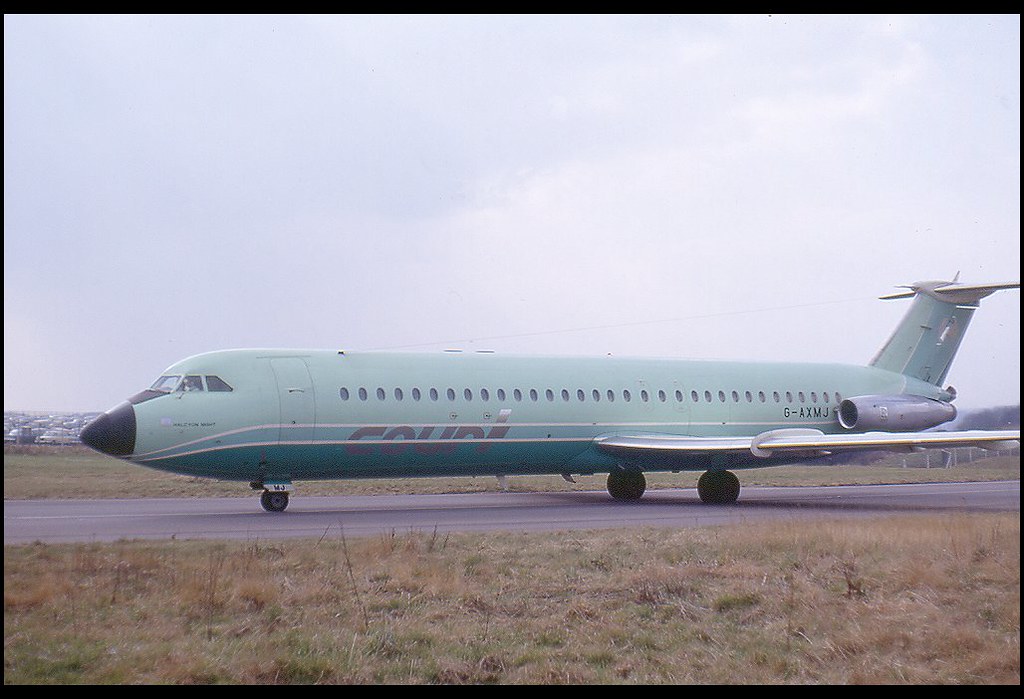
Court Line 1-11 G-AXMJ at London Luton. Photo (c) Clive R Martin
Court Line’s legacy lives on in photos of its flamboyant aircraft and in the memories of those who flew with the airline during its brief but impactful heyday. It helped popularise overseas holidays for ordinary Britons and brought colour—literally and figuratively—to the British airline industry.
Did you ever fly with Court Line? Or perhaps you remember seeing one of its colourful jets on the tarmac? Share your stories in the comments below!
Title image: Aero Icarus
 Get the Book
Lost Airline Colours of Europe is a pictorial guide to make of the lost airline and airline liveries from the glory days of air travel in Europe. It features many lost leisure airlines, as well as scheduled and cargo airlines. It also features colour pictures of many classic aircraft types, like the Caravelle, Boeing 727, 737-200, Tupolev Tu-154 and Vickers Viscount.



2 comments
I had left the UK in 1970 so missed the Court Line pastel shaded jets, however very familiar with AUTAIR Heralds and Ambassadors at Belfast airport mid 1960s. BRANIFF AIRLINES in the USA painted their aircraft in pastel shades and I did see some of these while in the US. Yes they were extremely ambitious, but left behind a dreadful legacy of owing so many organizations and individuals bucket loads of money.
One small correction. BAC One-Elevens were not built at Hatfield. That was Hawker Siddeley’s site where they built Tridents. One-Elevens were built by BAC’s factory at Hurn (Bournemouth).